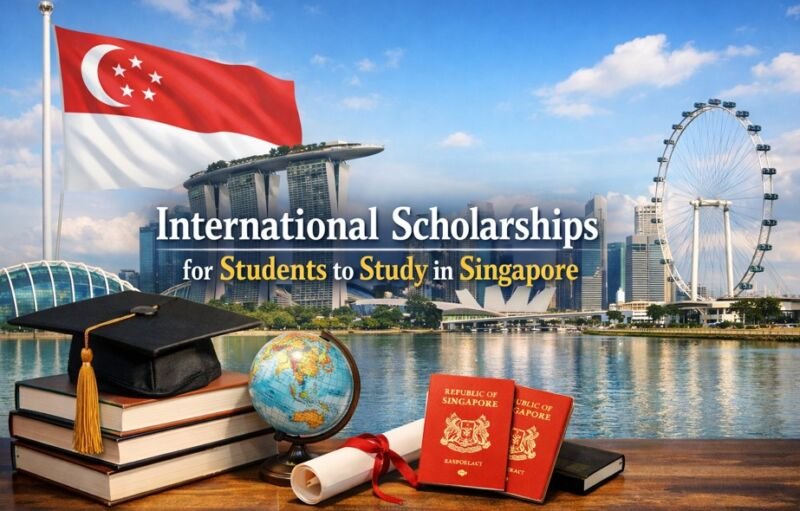
International Scholarships for Students to Study in Singapore have become the golden ticket for ambitious minds seeking a world-class education in the heart of Asia.
As a global hub for innovation, technology, and finance, Singapore offers an academic environment that is as rigorous as it is rewarding.
International Scholarships for Students to Study in Singapore are not merely financial grants; they are prestigious gateways that connect high-achieving students with top-tier universities like the National University of Singapore (NUS) and Nanyang Technological University (NTU).
Whether you are aiming for an undergraduate degree or a specialized PhD, the “Little Red Dot” provides a plethora of funded opportunities designed to nurture the next generation of global leaders.
Why Choose Singapore for Your International Studies?
The decision to pursue international scholarships for students to study in Singapore is often driven by the country’s reputation as a “Global Schoolhouse.” In 2026, Singapore continues to refine its position as a premier destination for higher education, blending rigorous academic standards with a high quality of life.
Below is an in-depth look at the primary reasons why scholars from around the globe are flocking to this island nation.
Unparalleled Academic Excellence and Global Rankings
Singapore’s commitment to education is reflected in the consistent world-class performance of its universities. Institutions like the National University of Singapore (NUS) and Nanyang Technological University (NTU) are perennial fixtures at the top of the QS World University Rankings and Times Higher Education lists.
For students chasing international scholarships for students to study in Singapore, this means access to a curriculum that is not only academically challenging but also globally recognized. The pedagogy here emphasizes critical thinking, interdisciplinary research, and practical application.
In 2026, the focus has shifted even more toward future-ready skills, with significant investments in AI, sustainability, and biotechnology, ensuring that a degree from Singapore carries immense weight in any international boardroom or research lab.
A Thriving Hub for Innovation and Research
Singapore has transformed itself into a “living laboratory” where new ideas are tested and scaled. For postgraduate students looking for international scholarships for students to study in Singapore, the research ecosystem is particularly enticing.
Through collaborations with the Agency for Science, Technology and Research (A*STAR) and various corporate labs, students can work on cutting-edge projects ranging from urban vertical farming to advanced quantum computing.
The government’s Research, Innovation and Enterprise (RIE) 2026 plan has funneled billions into these sectors, creating a fertile ground for scholars.
This culture of innovation encourages students to think beyond the classroom, fostering an entrepreneurial spirit that often leads to the birth of successful startups right within the campus incubators.
Exceptional Safety, Stability, and Quality of Life
For many international students and their families, safety is a non-negotiable factor. Singapore is globally renowned for its low crime rate and political stability, making it one of the most secure environments in the world to live and study.
In 2026, the city-state continues to lead in “Smart City” initiatives, offering a seamless quality of life characterized by efficient public transportation, high-speed connectivity, and world-class healthcare.
When you secure international scholarships for students to study in Singapore, you aren’t just gaining an education; you are gaining peace of mind. The urban planning is meticulous, providing lush green spaces and “garden city” aesthetics that offer a necessary reprieve from the rigors of intensive study.
Strategic Career Gateway to the Global Market
Singapore’s geographical and economic position makes it the “Gateway to Asia.” As a regional headquarters for over 7,000 multinational corporations (MNCs) and a growing number of unicorns, the professional opportunities for graduates are vast.
International scholarships for students to study in Singapore often come with industry attachments or internship requirements that provide students with a direct line to recruiters.
In 2026, sectors like cybersecurity, wealth management, and semiconductor engineering are facing significant talent shortages, making international graduates highly sought after.
The transition from student to professional is further eased by the government’s welcoming policies for high-skilled talent, often allowing scholars to build a career in one of the world’s most dynamic financial centers.
A Multicultural Environment with a Global Perspective
Living in Singapore offers a unique “East meets West” experience that is rare to find elsewhere. With four official languages; English, Mandarin, Malay, and Tamil, and a population representing a mosaic of ethnicities, students are immersed in a multicultural tapestry from day one.
This diversity is a core component of the educational experience, as it forces students to navigate different cultural nuances and viewpoints.
For those on international scholarships for students to study in Singapore, this environment fosters “Cultural Intelligence” (CQ), a soft skill that is increasingly vital in the globalized workforce of 2026.
Whether it is celebrating Deepavali, Chinese New Year, or Hari Raya, the shared festivals and common spaces like hawker centers create a sense of belonging that helps international students feel at home while developing a truly global mindset.
International Scholarships for Students to Study in Singapore
Exploring international scholarships for students to study in Singapore is the first step toward accessing a world-class education in one of the most innovative nations on earth.
In 2026, the competition for these awards remains high, but the rewards, ranging from full tuition coverage to monthly stipends, are unparalleled.
International scholarships for students to study in Singapore cater to diverse academic levels, from undergraduate freshmen to doctoral researchers.
Below is an expansive look at some of the most prestigious scholarship programs available for international students this year.
1. Singapore International Graduate Award (SINGA)
The SINGA scholarship is arguably the most sought-after award for research-oriented students globally. It is a collaboration between the Agency for Science, Technology and Research (A*STAR) and Singapore’s top four universities: NUS, NTU, SUTD, and SMU.
This fully funded PhD scholarship is designed specifically for international graduates with a passion for Science and Engineering. In 2026, the award provides a monthly stipend that increases from $2,700 to $3,200 once you pass your qualifying exams.
Additionally, it covers 100% of your tuition fees for four years and includes a one-time settling-in allowance and airfare grant. The goal of SINGA is to foster a vibrant, diverse research community that drives global innovation from within Singapore’s borders.
2. ASEAN Undergraduate Scholarship (AUS)
Specifically targeting the bright minds of Southeast Asia, the ASEAN Undergraduate Scholarship is offered to citizens of ASEAN member countries (excluding Singapore).
This scholarship is highly prestigious because it allows students to study at top-tier universities like NUS and NTU without the burden of tuition fees. In 2026, the benefits include a full tuition waiver and an annual living allowance of approximately $5,800.
While many scholarships in Singapore require a work bond, some variations of the AUS are bond-free, though most recipients opting for the MOE Tuition Grant will still serve a three-year bond in a Singapore-based company, providing them with a head start in their international professional careers.
3. Nanyang Scholarship (NTU)
The Nanyang Scholarship is Nanyang Technological University’s premier undergraduate award. It is strictly merit-based and awarded to outstanding freshmen who demonstrate exemplary co-curricular records and leadership potential.
For international students, this is a “full ride” experience. It covers all subsidized tuition fees and provides a generous annual living allowance of $6,500.
A unique highlight for 2026 is the inclusion of a travel grant worth $5,000 for overseas programs, encouraging scholars to broaden their horizons further. It also includes a $1,750 computer allowance, ensuring you have the latest tools to succeed in NTU’s tech-heavy environment.
4. NUS Science & Technology Undergraduate Scholarship
This scholarship is specifically earmarked for outstanding students from Asian countries (excluding Singapore) who are pursuing undergraduate degrees in Computing, Engineering, or Science (excluding Pharmacy and Environmental Studies).
It is one of the most targeted international scholarships for students to study in Singapore, aimed at fueling the nation’s tech sector. The coverage is comprehensive: it pays for your full tuition fees and provides an annual living allowance of $6,000.
Furthermore, recipients receive a $200 settling-in allowance and a guaranteed accommodation allowance. This scholarship is particularly valuable because it aligns students with Singapore’s strategic focus on the “Smart Nation” initiative.
5. Dr. Goh Keng Swee (GKS) Scholarship
Named after Singapore’s former Deputy Prime Minister, the Dr. Goh Keng Swee Scholarship is a private-sector award administered by the Association of Banks in Singapore (ABS). It is offered to citizens from 15 Asia-Pacific economies, including India, China, Japan, and most ASEAN nations.
Starting in 2026, the administration has shifted primarily to the National University of Singapore (NUS) to streamline the process. It covers tuition, airfare, a settling-in allowance, and a monthly subsistence allowance.
Upon graduation, GKS scholars are required to work for three years in either a Singapore-registered company or an approved Singapore-based organization, offering an immediate pathway into the financial or corporate sectors.
6. SMU Presidential Doctoral Fellowship
For those looking to advance their studies in Computer Science or Information Systems, the SMU Presidential Doctoral Fellowship is a top-tier choice. This fellowship is awarded to exceptionally qualified PhD candidates at the Singapore Management University.
In 2026, international students receive a significantly higher monthly stipend than the standard PhD scholarship, often reaching up to $3,600 after the qualifying stage.
This fellowship is designed to recognize and nurture research excellence, providing scholars with the resources to present their work at major international conferences and engage with global industry leaders in Singapore’s thriving fintech and tech-business landscape.
7. SUTD Global Excellence Scholarship
The SUTD Global Excellence Scholarship is designed for the modern “polymath”, students who excel in both design and technology. The Singapore University of Technology and Design (SUTD) offers this to top-tier international students who have achieved outstanding academic results.
The 2026 package is impressive, covering full tuition fees and providing a $6,000 annual living allowance. One standout feature is the Global Excellence Grant, which can be used to fund an overseas internship or a summer program at a partner university like MIT or Stanford.
This ensures that SUTD scholars are not just educated in Singapore but are exposed to global innovation ecosystems.
8. GIC Scholarship
The GIC Scholarship is provided by Singapore’s sovereign wealth fund. It is open to students of all nationalities who are interested in a career in global investment management. Unlike many academic-only awards, this is a “career scholarship.”
It covers all tuition fees, living allowances, and even provides opportunities for summer internships at GIC’s global offices in cities like London, New York, or Tokyo.
In 2026, GIC looks for students with a diverse range of majors, from Data Science and Economics to Sustainability, reflecting the evolving nature of global finance. This is an excellent choice for students who want a guaranteed, high-impact career waiting for them upon graduation.
9. President’s Graduate Fellowship
The President’s Graduate Fellowship is the pinnacle of graduate funding at NUS and NTU. It is awarded to PhD candidates who show exceptional promise in research and leadership.
For international students in 2026, the fellowship provides a monthly stipend of $3,000 and full tuition coverage. One of the primary advantages of this fellowship is the prestige it carries.
Being a “President’s Fellow” marks you as a top-tier researcher, often providing easier access to grant funding and collaborative opportunities with senior faculty members. It is typically bond-free, allowing for maximum career flexibility post-doctorate.
10. Lee Kong Chian Graduate Scholarship
Funded by the Lee Foundation, the Lee Kong Chian Graduate Scholarship is another premier PhD award at NUS. It is aimed at the brightest international and local students. The stipend for this award is generally higher than the standard research scholarship, reflecting the high bar for entry.
In 2026, the scholarship includes a monthly stipend, tuition fees, a book allowance, and a laptop allowance. It also covers the cost of a return airfare and a one-time settling-in allowance.
This award is highly competitive and is typically granted to students who have already demonstrated a significant track record of academic publication or innovative research.
11. Vingroup Young Talent Scholarship
This is a specialized award for Vietnamese students looking to pursue graduate studies (Master’s or PhD) at the Singapore Management University (SMU).
The Vingroup Young Talent Scholarship aims to find and develop talents who will eventually return to advance the science and technology sector in Vietnam.
It covers 100% of tuition fees and provides a monthly stipend that covers all living expenses in Singapore. In 2026, this scholarship focuses heavily on Information Systems, Computer Science, and Data Science, aligning with the regional demand for high-level technical expertise in the digital economy.
12. EDB Mid-Term Scholarship
The Economic Development Board (EDB) offers a Mid-Term Scholarship for international students who are already studying in Singaporean universities and have completed at least one year of their undergraduate degree.
This is a strategic move for students who may have missed out on freshman scholarships but have proven their worth through excellent university grades. The EDB is the lead agency for Singapore’s economic strategy, so scholars are groomed for leadership roles.
The scholarship covers the remaining tuition fees and provides a stipend. In exchange, scholars commit to a career with the EDB, working at the intersection of government and global business.
13. Kuok Foundation Scholarships
The Kuok Foundation offers scholarships specifically for Malaysian students who are pursuing undergraduate degrees at Singaporean public universities (NUS, NTU, SMU, SUTD). These awards are a combination of a grant and a “half-loan.”
In 2026, the foundation continues its mission of supporting students who demonstrate both academic merit and financial need. It covers tuition fees and living expenses.
Because of the close historical and economic ties between Malaysia and Singapore, these scholars often find it very easy to transition into the Singaporean workforce after their studies.
14. ADB-Japan Scholarship Program
The Asian Development Bank-Japan Scholarship Program (ADB-JSP) is available for students from ADB member countries who wish to pursue Master’s degrees in fields like Economics, Management, or Science and Technology at NUS.
This is a fully funded program that covers full tuition, a monthly subsistence allowance, housing, books, and medical insurance. In 2026, this program remains a vital resource for students from developing nations who want to gain advanced skills in Singapore to contribute to the development of their home countries.
It is one of the few programs that strictly requires the scholar to return home after their studies, ensuring a “brain gain” for the developing region.
How to Apply: A Step-by-Step Guide
To successfully navigate the landscape of international scholarships for students to study in Singapore, one must treat the application process as a multi-stage marathon rather than a sprint.
In 2026, the administrative systems for Singaporean universities and government bodies have become highly digitalized and integrated, requiring a high level of precision and digital savvy.
International scholarships for students to study in Singapore are awarded to those who not only meet the academic thresholds but also demonstrate a clear understanding of the application lifecycle. Below is an exhaustive, step-by-step guide to mastering your submission.
Phase 1: Strategic Research and University Alignment
The foundation of a successful application for international scholarships for students to study in Singapore lies in your ability to match your profile with the right institution.
In 2026, Singaporean universities have distinct “personalities”: NUS is often favored for traditional academic rigor and broad research; NTU is a powerhouse for engineering and technology; SMU focuses on leadership and business management; and SUTD is the home of design-thinking.
Your first step should be to deep-dive into the specific faculty pages of these universities. Check if your research interests align with a current professor’s work or if the undergraduate program offers the specific global exchange opportunities you desire.
Most scholarship failures occur because a candidate applies for a prestigious award without explaining why that specific university is the right fit for their unique career trajectory.
Phase 2: Meticulous Document Preparation and Verification
Once you have identified your target international scholarships for students to study in Singapore, you must begin the arduous task of gathering and verifying your documentation. In 2026, digital authenticity is paramount.
You will need high-resolution scans of your academic transcripts, but more importantly, many scholarships now require these to be verified via official channels or notarized if they are not originally in English.
Prepare a “Master Folder” that includes your valid passport, a professional passport-sized photograph (taken against a plain white background, as per Singaporean visa standards), and your updated CV.
Your CV should not just list grades; it should highlight “impact”, quantifiable achievements in extracurricular activities, volunteer work, or previous research projects that show you are a well-rounded contributor.
Phase 3: Crafting a Compelling Personal Statement
The personal statement is the soul of your application for international scholarships for students to study in Singapore. This is where you move beyond being a set of numbers and become a human being with a vision.
In 2026, scholarship boards are looking for “Cultural Intelligence” and a “Future-Ready” mindset. Avoid clichés like “I want to study in Singapore because it is a beautiful country.”
Instead, focus on specific modules, the innovation ecosystem, or how the three-year work bond (if applicable) aligns with your goal to work in a global financial hub.
Your essay should follow a logical narrative: where you came from, what challenge you’ve overcome, why Singapore is the only place to take your next step, and how you plan to give back to the community. Be reflective, be authentic, and most importantly, be specific.
Phase 4: Securing High-Impact Letters of Recommendation
Many applicants treat recommendation letters as an afterthought, but for international scholarships for students to study in Singapore, they are critical weight-bearing components. You typically need two referees who can speak to your academic prowess and your character.
In 2026, the process is usually automated: you provide the referee’s email in the portal, and the system sends them a secure link. Choose referees who actually know you, a professor who supervised your thesis is better than a Dean who only knows your name.
Approach them at least two months in advance. Provide them with a summary of the scholarship you are applying for and a list of your key achievements to help them write a letter that is specific, glowing, and aligned with the scholarship’s values.
Phase 5: Mastering Standardized Testing and Language Proficiency
While Singapore is an English-speaking nation, international scholarships for students to study in Singapore often require formal proof of proficiency for non-native speakers. Depending on the level of study, you may need to submit IELTS or TOEFL scores.
For postgraduate research awards like SINGA, a GRE score is frequently “highly recommended” or mandatory. In 2026, ensure your test scores are recent (usually within the last two years). Do not wait until the last minute to book these tests, as slots can fill up quickly during peak application seasons (September to January).
High scores in these standardized tests serve as a universal “quality stamp” that reassures the scholarship committee of your ability to keep up with Singapore’s fast-paced academic environment.
Phase 6: Navigating the Online Application Portals
The technical act of submission for international scholarships for students to study in Singapore requires patience. Most portals, such as the A*STAR SINGA portal or the NUS/NTU admission systems, allow you to save your progress.
It is vital to cross-check every entry. A common mistake is a mismatch between the name on the passport and the name on the application form. Ensure all uploaded PDFs are within the size limits and are clearly legible.
In 2026, many systems use AI-driven screening for initial rounds; this means using relevant keywords related to your field and the scholarship’s goals can help your application reach the desk of a human reviewer.
Always aim to submit at least two weeks before the deadline to avoid potential system crashes caused by last-minute global traffic.
Phase 7: Preparing for the Final Selection Interview
If you are shortlisted for international scholarships for students to study in Singapore, the final hurdle is the interview.
In 2026, these are almost exclusively conducted via high-definition video conferencing for international candidates. Dress professionally, ensure a stable internet connection, and use a neutral background.
The panel, usually consisting of senior faculty and government representatives, will probe your “Why Singapore?” and “Why you?” Prepare a “story bank” of experiences where you demonstrated leadership, resilience, or problem-solving.
They aren’t just testing your knowledge; they are testing your temperament and your potential to be an ambassador for Singapore on the global stage. Practice speaking clearly and confidently, and always have two or three thoughtful questions ready to ask the panel at the end.
Conclusion
The pursuit of international scholarships for students to study in Singapore is a journey toward excellence. By securing one of these awards, you are not just funding your education; you are positioning yourself in a vibrant, safe, and technologically advanced society that values talent above all else.