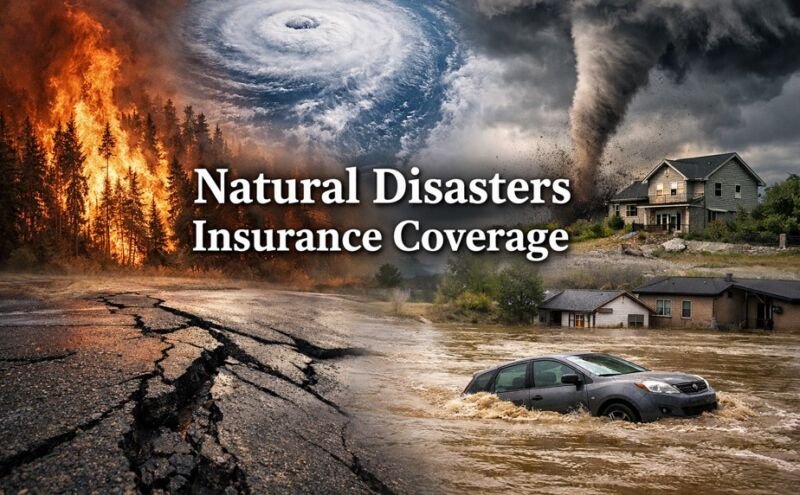
Natural disasters insurance coverage is no longer a luxury for the few but a critical necessity for every modern property owner.
As global weather patterns become increasingly unpredictable in 2026, understanding the specifics of your policy can be the difference between a swift recovery and a devastating financial loss.
Whether you are a first-time homeowner or a seasoned real estate investor, the landscape of protection has shifted, making it more important than ever to know exactly what stands between you and the elements.
Natural disasters insurance coverage often comes with a web of exclusions and “fine print” that can catch even the most diligent person off guard.
While many assume that a standard homeowners policy is an all-encompassing shield, the reality is that many of the most destructive forces of nature require specific, separate endorsements.
In this comprehensive guide, we will break down the complexities of modern policies, explore emerging trends like parametric insurance, and provide a roadmap for ensuring your assets remain secure regardless of the forecast.
What Does Standard Insurance Actually Cover?
Natural disasters insurance coverage is often misunderstood as a “catch-all” for any event involving the environment, but standard policies are actually quite specific about which “perils” they protect against.
To ensure you aren’t left with an expensive surprise after a storm, it is vital to understand the granular details of these covered events. Below, we expand on the most common natural disasters that are typically included in a standard homeowners policy.
Fire and Lightning:
Fire remains one of the most devastating perils a homeowner can face, and as such, it is a primary pillar of natural disasters insurance coverage. This coverage typically extends to fires caused by electrical malfunctions, kitchen accidents, and significantly, wildfires.
When a fire occurs, your policy doesn’t just cover the charred remains of the structure; it also covers smoke damage, which can be just as destructive to electronics, upholstery, and wall finishes. Lightning strikes are also covered under this umbrella.
If a bolt of lightning hits your home, causing a fire or an electrical surge that fries your appliances and home theatre system, your insurance is designed to step in.
It is important to note that this includes “indirect” strikes, where lightning hits a nearby transformer and sends a surge through your lines, as well as “direct” hits to the roof or chimney.
Wind and Hail:
Windstorm and hail coverage is essential for protecting the exterior envelope of your property. Under the umbrella of natural disasters insurance coverage, “wind” generally includes everything from standard thunderstorms and microbursts to more severe events like tornadoes and hurricanes (though some coastal areas may require a specific windstorm deductible).
If high winds rip shingles from your roof, shatter windows, or tear away siding, your dwelling coverage will typically pay for the repairs.
Hail damage is handled similarly; even if the damage is purely cosmetic, such as “pitting” on a metal roof or cracked vinyl siding, it is usually covered because it compromises the long-term integrity of the material.
A key detail to remember is that if wind or hail creates an opening in the roof or wall, any subsequent damage from rain or snow that enters through that hole is also generally covered.
Explosions and Volcanic Eruptions:
While they may seem like “movie scenarios,” explosions and volcanic eruptions are standard inclusions in most comprehensive natural disasters insurance coverage plans.
An “explosion” can result from a variety of natural or man-made triggers, such as a gas leak or a massive buildup of pressure within a structure. Volcanic eruption coverage is particularly interesting; it typically covers the direct results of an eruption, such as volcanic blast, airborne shockwaves, ash, dust, and lava flow.
If a volcanic event causes your home to be covered in heavy ash that results in a roof collapse, or if a lava flow consumes the property, the policy is triggered.
However, it is a crucial distinction that the earth movement associated with volcanoes, such as tremors or earthquakes, is almost always excluded and requires its own separate policy.
Falling Objects:
The “falling objects” peril provides a safety net for a variety of unexpected impacts from the sky. In the context of natural disasters insurance coverage, this most frequently applies to trees or heavy branches that are brought down by storms or decay.
However, the legal definition of “falling objects” is surprisingly broad; it can include everything from aircraft debris and satellites to meteors and space junk.
For a claim to be successful under this peril, the falling object must generally hit the exterior of the house first, causing a breach in the roof or a wall.
If a tree simply falls in your yard without hitting the house, insurance usually won’t pay to remove it unless it is blocking a driveway or a ramp designed for the disabled. This coverage ensures that even the most “random” aerial strikes don’t result in a total financial loss.
Weight of Ice, Snow, and Sleet:
For those living in colder climates, the “weight of ice, snow, and sleet” is a critical component of natural disasters insurance coverage. A massive accumulation of heavy, wet snow or a thick layer of ice can exert thousands of pounds of pressure on a roof.
If the structure reaches its breaking point and collapses, your insurance is there to cover the cost of rebuilding the roof and repairing any interior damage caused by the cave-in.
This peril also covers damage to attached structures, such as a carport or a porch, that might buckle under the frozen weight. It is important to distinguish this from “ice damming”, where melting snow refreezes at the gutters and backs up under the shingles.
While the resulting water damage is often covered, the “weight of ice” peril specifically addresses the physical collapse or structural failure caused by the sheer mass of the winter weather.
The “Big Exclusions”: What is NOT Covered
While a standard policy offers a solid foundation of protection, it is the gaps in natural disasters insurance coverage that often lead to the most significant financial hardships.
Many policyholders operating in 2026 still hold the dangerous misconception that “comprehensive” means “everything.”
In reality, insurance carriers categorize certain high-risk events as “excluded perils,” meaning they are specifically carved out of your primary policy. Understanding these “Big Exclusions” is the first step in building a truly resilient safety net for your property.
Flooding:
Flooding is statistically the most frequent and costly peril worldwide, yet it remains the most significant exclusion in standard natural disasters insurance coverage. To an insurance adjuster, “flooding” is defined very specifically: it is any water that touches the ground before entering your home.
This includes rising rivers, overflowing lakes, coastal storm surges, and even heavy surface water runoff from a severe rainstorm.
If a pipe bursts in your upstairs bathroom, your standard policy will likely cover the damage; however, if that same amount of water comes from a flash flood in your yard, you are completely on your own without a separate flood policy.
In 2026, with shifting weather patterns and updated flood maps, even homes in traditionally “low-risk” areas are finding themselves vulnerable.
Because standard policies exclude this, homeowners must look to specialized programs like the National Flood Insurance Program (NFIP) or private market flood insurers to secure this vital layer of protection.
Earthquakes and Seismic Activity: The Silent Exclusion
Despite the potential for total property loss, earthquake damage is almost universally excluded from standard natural disasters insurance coverage. This exclusion covers not just the initial “shaking and trembling” of the earth, but also the aftershocks that can follow for weeks.
The reasoning behind this exclusion is the “catastrophic risk” profile of seismic events, when an earthquake hits, it tends to damage thousands of homes simultaneously, which could bankrupt an insurer if it were included in every basic policy.
It is also important to note that this exclusion applies to more than just tectonic shifts; it typically includes any “earth movement,” such as tremors caused by volcanic activity.
While your standard policy might cover a fire caused by an earthquake (like a ruptured gas line), it will not cover the cracked foundation, collapsed walls, or shattered windows resulting from the ground movement itself.
For those in seismically active zones, adding a specific earthquake endorsement or purchasing a standalone policy is the only way to safeguard the structural integrity of the home.
Landslides, Mudflows, and Sinkholes: The “Earth Movement” Umbrella
Often grouped under a broad “Earth Movement” exclusion, landslides and mudflows are frequently misunderstood components of natural disasters insurance coverage. A common point of confusion is the difference between a “mudslide” and a “mudflow.”
A mudflow is a “river of liquid and flowing mud” and is occasionally covered by specialized flood insurance, but a landslide, where dry earth, rock, or debris falls down a slope, is almost never covered by standard or flood policies.
Similarly, sinkholes, naturally occurring cavities in the ground that can swallow portions of a structure, are excluded in most regions unless the policyholder has purchased a specific sinkhole rider.
These events are often excluded because they are seen as geological risks rather than sudden weather events.
Because the damage from a landslide or sinkhole is often total, homeowners on sloped terrain or in areas with limestone-heavy soil must be particularly diligent in seeking out “Difference in Conditions” (DIC) policies, which are specifically designed to fill these massive gaps in traditional coverage.
Maintenance Neglect and “Slow” Disasters
One of the most frustrating exclusions in natural disasters insurance coverage isn’t a disaster at all, but rather the “slow disaster” of maintenance neglect. Insurance is designed to cover events that are “sudden and accidental.”
Consequently, if a storm causes your roof to leak, but an adjuster determines the leak happened because the roof was 30 years old and poorly maintained, your claim could be denied.
This exclusion extends to “gradual deterioration,” such as mold that grows over several months due to a slow leak, or termite damage that weakens the structure over years.
Even during a major natural disaster, if the insurer can prove that the damage was exacerbated by pre-existing wear and tear or a failure to perform basic repairs, they may only pay a portion of the claim or deny it entirely.
In the 2026 insurance market, maintaining a meticulous log of home upgrades and inspections is no longer just good homeownership, it is a critical part of ensuring your insurance remains valid when you need it most.
Understanding the “Additional Living Expenses” (ALE) Clause
Natural disasters insurance coverage is designed to repair your physical property, but the Additional Living Expenses (ALE) clause is what protects your actual quality of life during the recovery process.
When a catastrophic event such as a wildfire or a severe windstorm renders your home uninhabitable, the financial burden of finding a temporary place to live can be staggering.
ALE coverage, also known as “Loss of Use,” is the specific component of your policy that steps in to cover the “extra” costs you incur because you can no longer live in your primary residence.
It is important to distinguish that this is not a flat stipend; rather, it is a reimbursement-based system designed to maintain your standard of living while your home is being rebuilt or repaired.
Natural disasters insurance coverage through the ALE provision essentially bridges the gap between your normal monthly budget and the inflated costs of emergency displacement.
For example, if your monthly grocery bill is typically $600, but because you are living in a hotel without a kitchen you are forced to spend $1,500 on restaurant meals, the ALE clause is intended to cover the $900 difference.
This coverage is triggered the moment a “covered peril” (like the ones we discussed earlier, such as fire or wind) makes the home unfit to live in.
In 2026, as construction timelines have stretched due to labor and material shortages, understanding the limits of your ALE coverage, both in terms of dollar amounts and time duration, is more critical than ever to ensure you don’t run out of funds before your front door is back on its hinges.
Temporary Housing and Emergency Relocation
The most significant portion of the ALE benefit within your natural disasters insurance coverage goes toward securing a roof over your head.
Depending on the extent of the damage and the estimated time for repairs, this could range from a few nights in a high-quality hotel to a multi-month lease on a furnished rental home that is comparable in size and location to your own.
The “comparable” aspect is key; the insurance company is generally obligated to help you find a living situation that mirrors your previous lifestyle. If you moved from a four-bedroom suburban home, they cannot force you to live in a one-bedroom studio apartment indefinitely.
This coverage also handles the logistics of relocation, such as the cost of moving your salvaged belongings into a professional storage facility or hiring movers to transition your family into the temporary rental.
Food, Fuel, and Incidental Cost Increases
Beyond housing, ALE covers the “excess” costs of daily life that arise directly from your displacement. This is a broad category that can include everything from increased commuting costs, if your temporary home is further from your workplace or your children’s school, to the cost of using a public laundromat if your rental doesn’t have a washer and dryer.
Even pet boarding fees can be covered if your temporary housing doesn’t allow animals. To make a successful claim, you must be meticulous about record-keeping. In the digital landscape of 2026, many homeowners use mobile apps to scan and categorize every receipt in real-time.
Because ALE only pays for the increase over your normal expenses, having a clear “baseline” of what you usually spend on gas, food, and utilities is essential for a smooth reimbursement process.
Prohibited Access and Civil Authority Coverage
A unique and often overlooked feature of the ALE clause within natural disasters insurance coverage is “Prohibited Access” or “Civil Authority” coverage. This applies even if your home hasn’t been touched by a flame or a drop of water.
If a local government or fire department issues a mandatory evacuation order due to a nearby threat, such as a neighboring wildfire or a chemical leak caused by a storm, your ALE coverage may kick in to pay for your hotel and meals during the evacuation period.
Typically, this coverage is limited to a shorter window (often two weeks), but it provides an essential financial cushion during those chaotic 48 to 72 hours when you are forced to flee your home with nothing but a suitcase.
Knowing that your insurance will foot the bill for a safe place to stay allows you to prioritize your family’s safety without hesitating over the cost of a last-minute hotel booking.
Key Steps to Optimize Your Coverage Today
Optimizing your natural disasters insurance coverage is an ongoing process that requires more than just paying your monthly premium. In the rapidly shifting environmental landscape of 2026, a policy that was sufficient two years ago may leave you dangerously exposed today.
To move from basic protection to true financial resilience, you must take a proactive approach to auditing your policy and documenting your assets.
By following the comprehensive steps, you can ensure that if a disaster strikes, your insurance functions exactly as intended, as a robust safety net rather than a source of further stress.
1. Conduct a Comprehensive Replacement Cost Audit
One of the most critical errors homeowners make regarding natural disasters insurance coverage is confusing their home’s “market value” with its “replacement cost.”
Market value is what a buyer would pay for your home and land, but replacement cost is what it would actually cost to rebuild your home from the ground up at today’s prices for labor and materials.
In 2026, supply chain fluctuations and the rising cost of sustainable building materials mean that reconstruction costs are often significantly higher than a home’s resale value. To optimize your coverage, you should contact your agent for a “Replacement Cost Estimate.”
This audit ensures that your dwelling coverage limit is high enough to cover modern construction fees, debris removal, and the cost of bringing an older home up to current building codes, an expense that can add tens of thousands of dollars to a claim if you don’t have a “law and ordinance” endorsement.
2. Create and Maintain a Detailed Digital Inventory
When filing a claim under your natural disasters insurance coverage, the burden of proof lies with you, the policyholder. Trying to remember every item in your kitchen cabinets or the brand of the electronics in your living room while standing in the aftermath of a disaster is nearly impossible.
To optimize your recovery, use your smartphone to create a room-by-room video inventory of your entire home. Open every drawer, closet, and storage bin, narrating the approximate age and cost of high-value items as you go.
Once completed, upload this footage to at least two secure cloud storage services. Having a timestamped digital record not only speeds up the claims process but also ensures you receive the maximum payout for your personal property, as it leaves no room for the insurance company to dispute the existence or condition of your belongings.
3. Verify “Replacement Cost” vs. “Actual Cash Value” for Contents
Not all natural disasters insurance coverage is created equal when it comes to your personal belongings. It is essential to check whether your policy provides “Replacement Cost Value” (RCV) or “Actual Cash Value” (ACV) for your contents.
ACV coverage only pays you what your items are worth today, factoring in years of wear and tear (depreciation). For example, a five-year-old television that originally cost $1,000 might only be worth $200 under an ACV policy.
RCV coverage, however, pays you the amount required to buy a brand-new, similar item at current market prices.
While RCV policies come with slightly higher premiums, the difference in your total payout after a major disaster can be life-changing. Switching to RCV is one of the most effective ways to ensure you can actually refurnish your life after a total loss.
4. Review and Strategize Your Deductibles
Optimizing your natural disasters insurance coverage often involves a delicate balance between your monthly premium and your out-of-pocket costs during a claim.
Many modern policies in disaster-prone areas now feature “percentage deductibles” for specific perils like wind, hail, or earthquakes.
Unlike a standard $1,000 flat deductible, a 2% wind deductible on a $500,000 home means you would have to pay $10,000 out of pocket before the insurance kicks in. Review your policy declarations page to identify these hidden costs.
If you have a high percentage deductible, ensure you have an emergency fund specifically earmarked for that amount.
Conversely, if you have a healthy savings account, you might choose to increase your deductible to lower your monthly premiums, allowing you to reinvest those savings into additional riders or flood insurance.
5. Leverage Mitigation Discounts and Bundling
In 2026, insurance carriers are increasingly rewarding homeowners who take active steps to protect their properties. To optimize your natural disasters insurance coverage financially, ask your provider about “mitigation discounts.”
You may be eligible for significant premium reductions if you install a monitored fire and burglar alarm, upgrade to an impact-resistant roof, or install smart water-leak sensors that can shut off your main valve automatically.
Additionally, bundling your homeowners, auto, and specialized disaster policies (like flood or earthquake) with a single carrier often triggers a “multi-line discount.”
This not only lowers your overall cost but also simplifies the claims process, as you only have one point of contact if a massive storm damages both your home and the vehicle parked in your driveway.
Conclusion
Navigating the world of natural disasters insurance coverage requires a proactive mindset. By understanding the gaps in standard policies and investing in the right riders and endorsements, you turn a potential catastrophe into a manageable hurdle. Don’t wait for the clouds to darken to check your policy, peace of mind starts with a thorough review today.